Spring
In my microtonal music, I often wonder about how to contextualize the harmony within the broader context of our societally attuned ear. One of my goals with this album was to write just intonation music that felt aligned with the equal tempered, diatonic ambient electronica of the 80s.
Each track in Spring, my album of electronic pseudo-ambient music (and part of my Happy Plant project), uses a just intonation scale that consists of twelve harmonics over a C fundamental. “Under the Canyon Bridge on a Rainy Day” uses a scale generated from harmonics 8-14 on both C and G, giving a scale of 32:33:36:39:40:42:44:48:52:54:56:60:64 (33/32, 9/8, 39/32, 5/4, 21/16, 11/8, 3/2, 13/8, 27/16, 7/4, 15/8, 2/1). The opening harmony is familiar, like the arpeggiated piano chord near the beginning of the piece, an ostinato alternating a 2:3:9 chord (very close to ubiquitous equal temperament) with 8:12:15—the major seventh perhaps a less alien 5-limit sonority than the major third (5/4) would be.
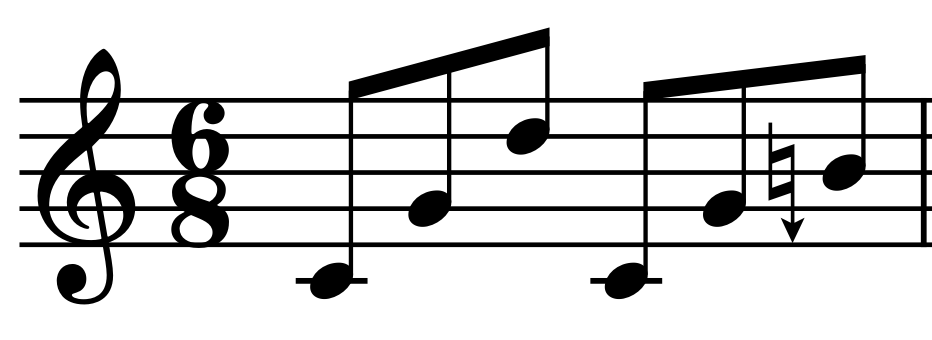
But as I often do in my microtonal music, the harmony begins familiarly and then gradually adds more and more exotic harmony. About three minutes in, the whole ostinato transposes to begin on “F”—21/16. Now the ostinato alternates between 21:32:54, with a septimal major tenth, and 21:32:40. The wide 32/21 fifth in each case is so unstable that when the ostinato steps down the scale to start on 5/4, the first triad (a simple minor triad 1/1-3/2-12/5 on 5:15:24) sounds like a consonant resolution. I’m not sure most listeners would be attuned to the dissonance in the 21:32:54 triad to begin with, though, since the ostinato by this point has quit sounding harmonic in a functional sort of way, and so this harmony may sound more like a gentle detuning, like Grandma’s basement piano effect than intentional dissonance (I can’t count how many times someone has compared my microtonal music to the forgotten basement piano or the camp lodge piano or some such...).
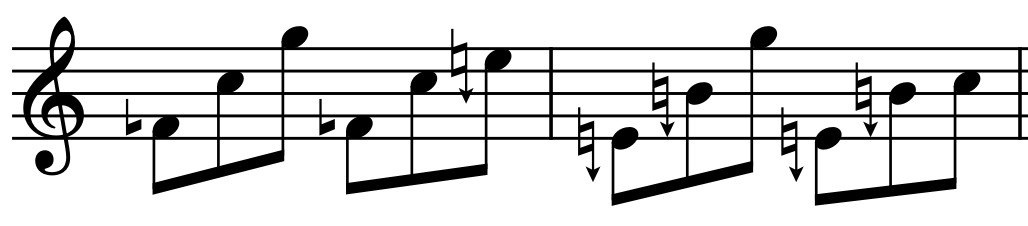
In the next passage, about five minutes in, the ostinato goes back to the harmony from the beginning of the piece. This time, the arpeggio is more complex, involving nearly all the diatonic pitches over C: 1/1, 9/8, 5/4, 3/2, 27/16, 15/8. You would expect the missing pitch to be 4/3, but instead, toward the end of the ostinato, 11/8 makes its appearance, and this time, the result is really exotic. Still, a listener would have to be astute to notice—it’s an exotic pitch buried in a texture, beneath a melody that never quite transgresses familiar expectations for pitch.

Once the melody finishes off, the piece closes as it opened, with focus on the ostinato arpeggiations in the piano. Now, finally, the exotic pitch content is front and center, and a listener has gone gently—perhaps unnoticeably—from the realms of familiarity to the fresh world of extended just intonation.
